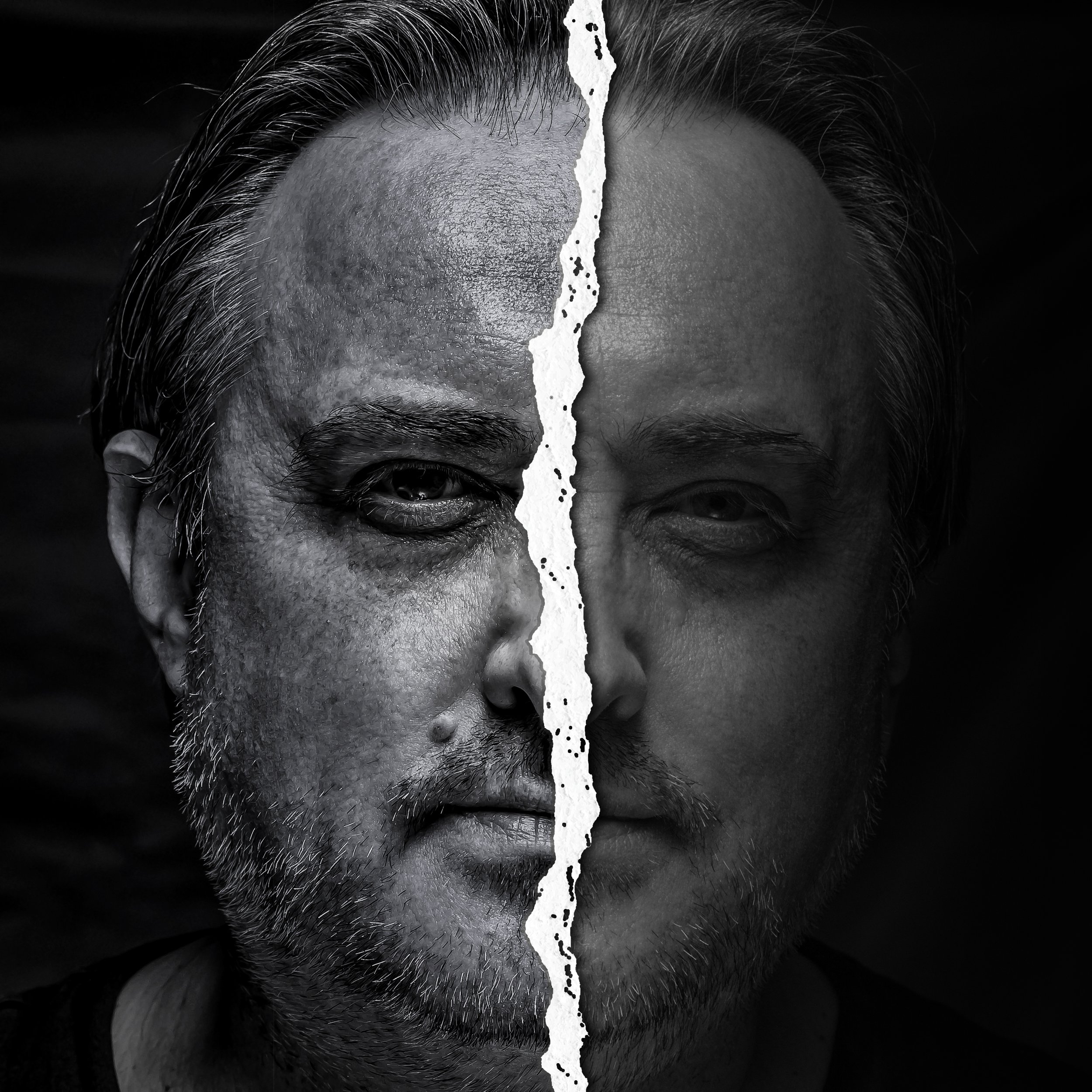

In 1944, Edith Piaf was offered to perform for French prisoners in a German prisoner of war camp. After the performance, Edith demanded to take a photo with the prisoners as a souvenir. Upon returning, she and her secretary Andre Bigard enlarged the photos, cut out the faces of each prisoner, and ordered 120 fake passports.
After this, Piaf returned to the same camp for a second concert. Edith carried the documents in a suitcase with a false bottom and, while signing autographs, handed them to the prisoners. All 120 prisoners managed to escape.
The painting that became the first artistic critique of the Nazi regime. The “Threat” is a work by the German artist Rudolf Dischinger 1, created in 1935.

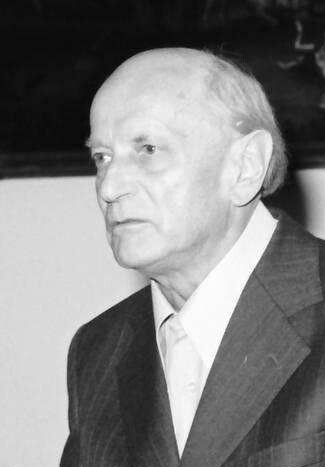
When the Nazis came to power in 1933, some of the leading artists of the Weimar Republic fled the country, but most stayed. In order to exhibit, they had to find ways to avoid the scrutiny and wrath of Goebbels and his cronies. The most daring, including Rudolf Dischinger, criticised the society of the “New Germany” through allegory.
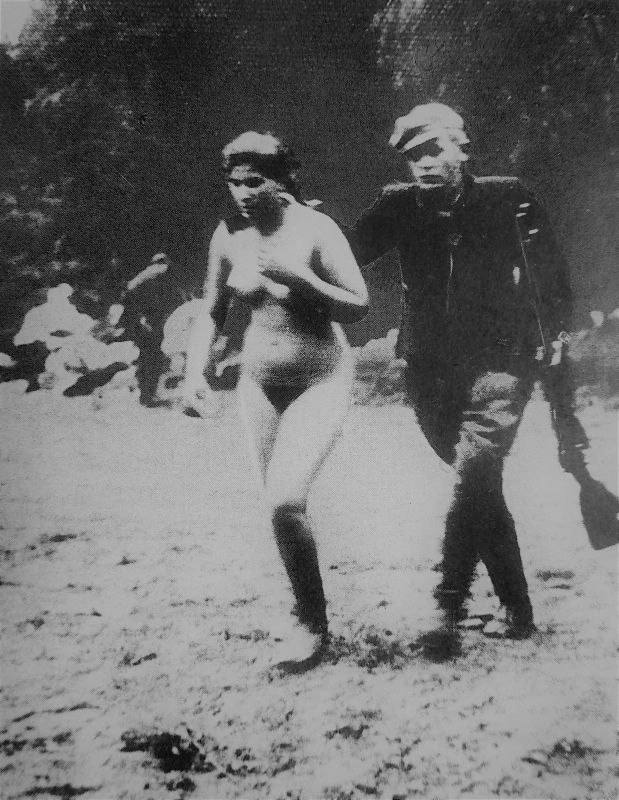

The Estonian national units were first established on August 25, 1941. During the entire war, 26 police battalions “Schutzmannschaf” 2 were formed in Estonia. The police battalions were entirely composed of ethnic Estonians, with only German inspectors among their ranks. As of October 1, 1942 the Estonian auxiliary police units numbered about 10,000 people.

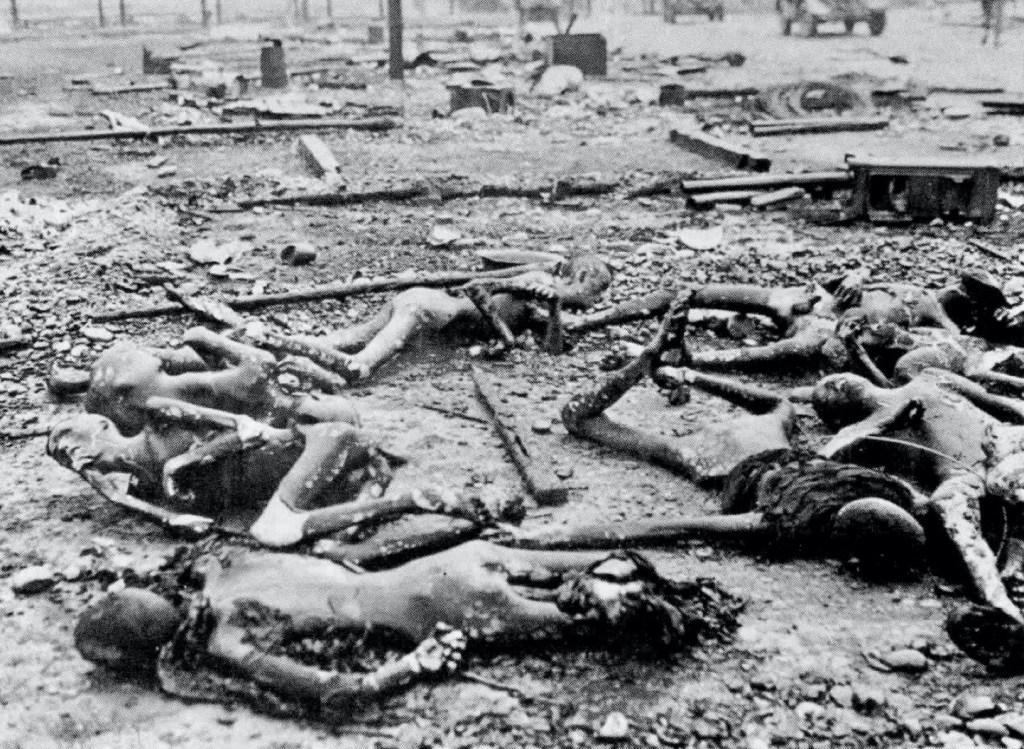
Former commandant of the Kaufering concentration camp (Kaufering IV, a branch of the Dachau concentration camp), SS man Johann Baptist Eichelsdörfer (1890-1946, dressed in civilian clothes), stands among the bodies of murdered and typhus-stricken concentration camp inmates. In the background, German civilians are digging graves. On December 13, 1945, he was sentenced to death by the court; the sentence was carried out in Landsberg Prison on May 29, 1946.
- Rudolf Dischinger is an important protagonist of New Objectivity and Surrealism in Germany, but has also proven an important contribution to Concrete Art. His work covers a period of about 60 years and leads from the sober inventory of a world of objects to surreal alienations to strict geometric forms. He received decisive impulses during his studies at the Grand Ducal Baden School of Art in Karlsruhe with Georg Scholz, Karl Hubbuch and Ernst Württenberger. Characteristic remains the preference of graphic accuracy over a subjective expression. Dischinger strips the objects (shells, dolls, etc.) of their functional context and thus tries to capture their “own life”, the “magic of things”. Dischinger’s feeling for the significance of the sign-like was decisively fostered by his acquaintance with Bissier. – Galerie Schlichtenmaier ↩︎
- The Schutzmannschaft (Auxiliary Police) were batallions of local and German units in German-occupied Eastern Europe, that participated in the Holocaust in World War II. ↩︎


 Couple of Words
Leave a reply to John Cancel reply