In the early 1920s, Frederick Banting1 and Charles Best2 discovered insulin under the guidance of John Macleod3 at the University of Toronto.
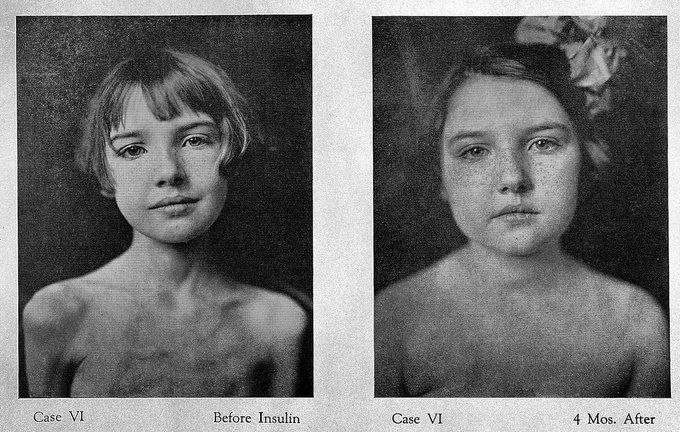
In 1922, a group of scientists traveled to Toronto General Hospital, where diabetic children were housed in wards, often 50 or more at a time. Most were comatose and dying of diabetic ketoacidosis. Others were being treated by putting them on an extremely strict diet that inevitably led to starvation.
These children were essentially on their deathbeds, awaiting their inevitable death. The scientists acted quickly and began injecting the children with a new purified insulin extract. As they began injecting the last child in a coma, the first child to be injected began to wake up.
Then, one by one, all the children awoke from their diabetic coma. The room, filled with death and gloom, suddenly became a place of joy and hope.
- Sir Frederick Grant Banting was a Canadian pharmacologist, orthopedist, and field surgeon. For his co-discovery of insulin and its therapeutic potential, Banting was awarded the Nobel Prize in Physiology or Medicine with John Macleod. ↩︎
- Charles Herbert Best, was an American-Canadian medical scientist and one of the co-discoverers of insulin with Frederick Banting. He served as the chair of the Banting and Best Department of Medical Research at the University of Toronto and was further involved in research concerning choline and heparin. ↩︎
- John James Rickard Macleod, a Scottish physiologist who shared the 1923 Nobel Prize in Physiology or Medicine for his work on insulin. ↩︎


 Couple of Words
Leave a comment