
A picture taken by Adam Diston1 in 1886. He was a painter who became a photographer. At his shop he took regular portraits and posed composition shots like this. He also produced “Cartes de Visite”2 of both outdoor views and portraits.
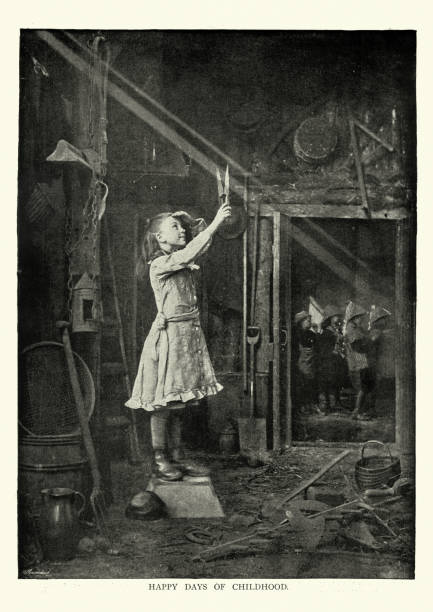
On the picture you can see a girl trying to cut a sunbeam. Surrounded by decay and refuse, this young girl, smiling, can imagine what it would be like to cut into the sun. We all need to tune into that small sense of wonder we had as children every now and again.
- Adam Diston (1827 – 1906) was born in Edinburgh. He had a long career as a professional photographer in Fife, and won many medals at international photography exhibitions. ‘Est.1855’ on his photographs the date he set up his own painting business, when he would have been 28. The 1861 Parochial Directory for Fife and Kinross gives Adam Diston two separate listings at No.58 High Street, Leven, as a photographer and calotypist, and as a painter and paperhanger. This marks a significant transition between one trade and another. 1861 may be the first year of his photographic business. Gael Newton, Senior Curator of Photography at the National Gallery of Australia stated that the gallery owns two genre scene ‘compositions’ as albumen silver photographs effectively laminated on the back of a sheet of glass and dated 1886. Both are by Adam Diston though it is unclear whether these are by Adam senior or Junior. ↩︎
- The carte de visite was a format of small photograph which was patented in Paris by photographer André Adolphe Eugène Disdéri in 1854, although first used by Louis Dodero in 1851. Each photograph was the size of a formal visiting card about 4½ x 2½ inches and such photograph cards, in an early form of social media, were commonly traded among friends and visitors in the 1860s. Albums for the collection and display of cards became a common fixture in Victorian parlors. The popularity of the format and its rapid uptake worldwide were due to their relative cheapness, which made portrait photographs accessible to a broader demographic, and prior to the advent of mechanical reproduction of photographs, led to the publication and collection of portraits of prominent persons. It was the success of the carte de visite that led to photography’s institutionalisation. ↩︎

 Couple of Words
Leave a comment